Creating Insecurity: Realism, Constructivism, and Us Security Policy by Anthony D Lott
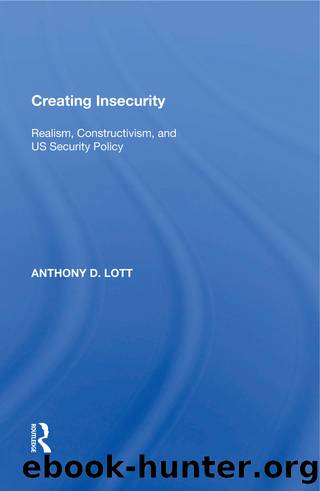
Author:Anthony D Lott [Lott, Anthony D]
Language: eng
Format: epub
Tags: Political Science, General
ISBN: 9780815388272
Google: 8WSzDwAAQBAJ
Goodreads: 40684078
Publisher: Routledge
Published: 2018-06-28T00:00:00+00:00
Enhancing Security
Balancing the disparate political visions (and the corresponding policy directives) offered by realists and political constructivists, a more robust security analysis is possible. In tenns of U.S. BMD deployment, this balance occurs when we recognize the realist concern for maintaining adequate capabilities and the political constructivist concern for understanding the role identities play in the articulation of foreign policies. Neither approach, on its own, can provide a comprehensive critique of the U.S. decision to deploy ballistic missile defenses. In this final section, I will examine how the alternative strategies posed by realists to enhance nuclear security (without recourse to BMD) are complemented by the critique offered by political constructivists. Realists have offered several alternatives to the deployment of BMD in an effort to make the United States more secure in the face of the nuclear threat. These solutions are intended to supplement (rather than undermine) the strategy of deterrence. I will discuss three issues that both enhance national security and work within a realist strategy: (1) an agreement to de-alert nuclear weapons, (2) practical programs to reduce the proliferation of nuclear weapons and technology, and (3) diplomatic efforts to deal with potential nuclear rogues.
First, in the event of an accidental nuclear attack, proponents of BMD technology argue that defenses can be effective. An accidental launch is most likely to occur among the established nuclear powers that have developed sophisticated command and control systems. For example, the deteriorating Russian system is thought to be prone to an accidental of inadvertent launch because its intricate system is stretched beyond normal operating capacities. Realists have countered that such a launch would most likely overwhelm any BMD system.109 But, it is their solution to the problem of accidental launches that is important in the current discussion. Realists advocate a series of policy options that are both more effective and efficient than BMD. An international agreement to 'de-alert' nuclear missiles would provide both the United States and Russia (and any other nuclear power) with a cost-effective means of preventing an accidental firing while maintaining a cogent deterrent. 'De-alerting would amount to de-mating, meaning the physical separation of missile warheads from launchers.'110
109 Glaser and Fetter, p. 43.
110 Newhouse, p. 99.
However, a successful agreement would require the United States to accept a regime to monitor the status of de-alerted nuclear missiles. Such transparency is not necessarily a problem. Cooperation that enhances self-help security promotion is valuable.111 As long as realists could be relatively assured that opposing nuclear missiles had been successfully de-alerted, the security of the United States could be considered enhanced. The problem for realists is appreciating the challenge posed by identity constructs. If policy makers in the United States continue to define the state as a global hegemon with unbounded freedom of action, it will be exceedingly difficult to bind the United States to any international agreement â even if that agreement appears in the interest of the state. Understanding the necessity of reconstructing identities, political constructivism is a further requirement. Here, the challenge
Download
This site does not store any files on its server. We only index and link to content provided by other sites. Please contact the content providers to delete copyright contents if any and email us, we'll remove relevant links or contents immediately.
The Vikings: Conquering England, France, and Ireland by Wernick Robert(84383)
Ali Pasha, Lion of Ioannina by Eugenia Russell & Eugenia Russell(40318)
The Conquerors (The Winning of America Series Book 3) by Eckert Allan W(37983)
The Vikings: Discoverers of a New World by Wernick Robert(37006)
Cecilia; Or, Memoirs of an Heiress — Volume 1 by Fanny Burney(32636)
Cecilia; Or, Memoirs of an Heiress — Volume 2 by Fanny Burney(32010)
Cecilia; Or, Memoirs of an Heiress — Volume 3 by Fanny Burney(31996)
Empire of the Sikhs by Patwant Singh(23135)
The Secret History by Donna Tartt(19297)
Hans Sturm: A Soldier's Odyssey on the Eastern Front by Gordon Williamson(18650)
Cat's cradle by Kurt Vonnegut(15443)
Pimp by Iceberg Slim(14667)
Sapiens: A Brief History of Humankind by Yuval Noah Harari(14461)
Norse Mythology by Gaiman Neil(13458)
Talking to Strangers by Malcolm Gladwell(13440)
Leonardo da Vinci by Walter Isaacson(13411)
4 3 2 1: A Novel by Paul Auster(12513)
Underground: A Human History of the Worlds Beneath Our Feet by Will Hunt(12145)
The Radium Girls by Kate Moore(12094)
